TWO:This essay on the ¡®Imagination¡¯ was published soon after the ¡®Crimes and Punishments¡¯ in the periodical to which Beccaria alludes in his letter to Morellet. ¡®The Caff¨¦¡¯ was the name of the periodical which, from June 1764, he and his friends published every tenth day for a period of two years. The model of the paper was the English ¡®Spectator,¡¯ and its object to propagate useful knowledge pleasantly among the Milanese, whilst its name rested on the supposition that the friends who composed it executed their labours during meetings in a coffee-house. The most interesting contributions to it by Beccaria are his ¡®Fragment on Style,¡¯ his article on ¡®Periodical Newspapers,¡¯ and his essay on the ¡®Pleasures of the Imagination.¡¯
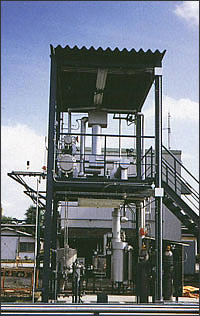
Great attention is recently being paid to global environmental issues, and it is now conceivable that companies will need to treat used solvents themselves. In consideration of this kind of social issue, we have developed a “membrane separation type solvent dehydration system,” which uses a polyimide membrane with superior dehydration properties developed by Ube Industries, Ltd. in combination with our own distillation and concentration technology that has resulted in solvents being more easily recovered.
THREE:Torture, again, is inflicted upon an accused man in order to discover his accomplices in crime. But if it is proved that it is not a fitting method for the discovery of truth, how will it serve to disclose accomplices, which is part of the truth to be discovered? As if a man who accuses himself would not more readily accuse others. And is it just to torment men for the crimes of others? Will not the accomplices be disclosed from the examination of the witnesses and of the accused, from the proofs and whole circumstances of the crime; in sum, from all those very means which should serve to convict the accused himself of guilt? Accomplices generally fly immediately after the capture of a companion; the uncertainty[155] of their lot of itself condemns them to exile, and frees the country from the danger of fresh offences from them; whilst the punishment of the criminal who is caught attains its precise object, namely, the averting of other men by terror from a similar crime.Since, therefore, there is more to fear from a punished than from an unpunished criminal, there is the less reason to regret the general impunity of crime. There is indeed a large class of crimes for the prevention of which more would be done, by leaving them to their natural consequences, and to the strong power against them which the general interests and moral feelings of mankind will always enforce, than by actual punishment. It is particularly crimes of dishonesty which are best punished by the mere fact of their discovery. By the Norwegian law if an offender holds any official place he is punished, not by fine or imprisonment, but by the loss of his office and all the privileges connected with it.[59] And if we imagine a country without any legal penalty at all for theft or dishonesty, thieves and their tribe would soon find their proper punishment, by that process of social shifting, which would drive them to the most deleterious or dangerous occupations of life even more effectually than it so drives them at present. The less dependence is placed on the penal sanctions of crime, the stronger do the moral restraints from it become.
- 1Under the distillation system, even in case of azeotropic solvent compositions, this system which remove water vapor by the polyimide membrane will easily dehydrate.
- 2In comparison with the distillation system, it significantly saves on use of steam.
- 3Dehydration can be performed through merely supplying evaporated vapor to the membrane module and maintaining the differential pressure between the permeable side and the impermeable side.
- 4Solvent purity of 99.9% or more can be achieved by carrying out dehydration with a polyimide membrane only.
- 5The polyimide membrane has superior heat and solvent resistance. Therefore, the vapor permeation system reduces contamination of the membrane and thus extends its life.
THREE:3. When the proofs are independent of each other¡ªthat is to say, when they do not derive their value one from the other¡ªthen the more numerous the proofs adduced, the greater is the probability of the fact in question, because the falsity of one proof affects in no way the force of another.
The aromatic polyimide membrane is highly permeable to water vapor but less permeable to vapors of organic compounds such as alcohol etc.
THREE:Adultery is a crime which, politically considered, derives its force and direction from two causes, namely, from the variable laws in force among mankind, and from that strongest of all attractions which draws one sex towards the other.[70]
- 1 Recovery of the detergent solvent Recovery of the cleaning solvent such as electronic parts industry, precision instrument industry.
- 2Solvent recovery and the refinement Solvent recovery and the refinement such as chemical industry, an industry of medical supplies, food industry, the fermentation industry.
THREE:
Acetone, ethanol, methyl ethyl ketone, butanol, isopropyl alcohol, ethyl acetate, methyl isobutyl ketone, others (including hexane and toluene).
